How to Convert Dental Website Visitors Into Booked Appointments
Dental website conversion rises when practices judge the site by booked appointments, fix the booking path, and match landing pages to search intent.
Dental website conversion is the rate at which people who visit a dental practice website become booked appointments—not just sessions, clicks, or form starts. That definition matters because SEO, Google Ads, and directory traffic only pay for themselves when the schedule fills. A site that looks polished but hides the phone number, buries “Book,” or sends every keyword to a vague homepage quietly raises cost per booked patient. This guide explains what to count as a conversion, how to fix the booking path before buying more traffic, how to match landing pages to search intent, how to read a labeled funnel example, and which metrics show whether the website is earning its keep.
Dental Website Conversion Means Booked Appointments, Not Sessions
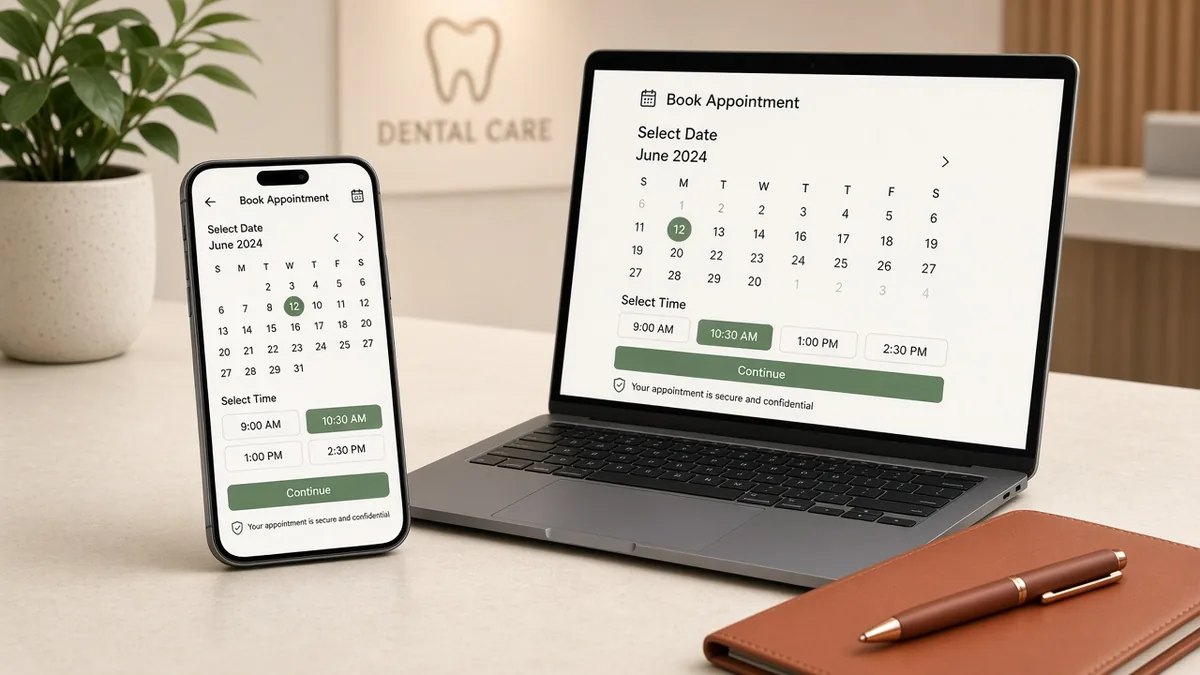
Dental website conversion should be judged by scheduled patients. A session, a bounce rate improvement, or even a completed “contact us” form is only a step toward conversion if the practice can prove that step became a booked appointment.
Practices that optimize for vanity traffic often celebrate rising pageviews while chairs stay empty. That pattern usually means the site is easy to browse and hard to act on: the primary call to action is unclear, the phone number is not clickable on mobile, or the form asks for more fields than a new patient will give before they trust the office.
Treat three outcomes as the conversion ladder:
- Primary conversion: a booked appointment (online scheduler confirmation or a call that ends with a scheduled visit)
- Secondary conversion: a qualified inquiry the front desk can schedule same day (tracked call, short form, or chat that captures intent)
- Non-conversion: anonymous browsing, brochure downloads, or form spam that never reaches the book
When leadership asks whether the website is “working,” answer with booked appointments and cost per booking influenced by the site—not with “traffic is up.” How patients choose a dentist online shows why people shortlist offices quickly; dental website conversion is what happens after they click through to yours.
Fix the Booking Path Before Buying More Traffic
If the booking path is broken, more SEO or ads multiplies waste. Repair the path patients use to schedule before increasing spend.
Put phone and book above the fold on mobile
Most local dental searches happen on phones. The first screen of the homepage and every service page should show a tap-to-call number and one clear booking action—online schedule or “Request appointment.” Decorative hero videos that push both actions below the fold cost real inquiries. Hours and location should be visible without hunting through the footer.
Send service intent to service pages, not only the homepage
Someone searching for Invisalign, emergency dentistry, or implants is not looking for a generic welcome message. Dedicated service pages with a matching headline, proof the practice offers that care, and a single primary CTA convert better than a catch-all homepage. Keep NAP details consistent with Google Business Profile and directories so trust does not break mid-path—see NAP consistency for dentists when listings disagree with the site.
Cut form friction
Long forms with insurance ID, employer, referral source, and a paragraph of medical history before the first visit often kill dental website conversion. Ask for name, phone or email, preferred time window, and reason for visit. Everything else can wait until confirmation or the new-patient packet. Test the form on a real phone: keyboard type, autofill, and submit errors matter more than desktop mockups.
Prefer scheduling over vague “contact us”
“Contact us” pages that promise a callback in 1–2 business days lose patients who already called two other offices. Online scheduling (or a short request that the desk answers the same day) turns intent into a calendar hold. If the practice cannot offer open self-scheduling, say when someone will respond and keep that promise.
Related reading: Why dental leads don’t book covers what happens after interest exists but the schedule never fills—the same leak, one step later in the funnel.
Match Landing Pages to Search Intent
Dental website conversion rises when the landing page matches why the visitor arrived. Organic and paid traffic should not share one generic URL for every keyword.
High-intent local and service queries deserve pages that answer:
- What service or visit type is offered
- Who it is for (new patient, emergency, consult)
- What happens next (call, book, or request)
- Proof the practice is real and reachable (photos, reviews summary, address, hours)
Dental SEO and GEO build durable pages for those queries. Google Ads management for dentists should send clicks to the same quality of landing experience—not a homepage that forces patients to hunt. Dental SEO vs Google Ads explains when each channel should lead; both fail when the landing page does not convert.
Avoid mismatched offers. An ad for “same-day emergency dentist” that lands on a cosmetic gallery wastes spend and trains Google that the practice is a poor destination. Align keyword, ad copy, page headline, and CTA so dental website conversion reflects true demand.
Illustrative Conversion Math (Example Only)
The numbers below are an example, not an industry benchmark. Markets, fee schedules, and traffic quality differ.
Assume a dental practice website in one month:
- Website sessions from SEO, ads, and direct: 2,000
- Click-to-call + form submissions + scheduler starts: 80 (4% of sessions become inquiries)
- Booked appointments from those inquiries: 40 (50% inquiry-to-book)
- Blended marketing spend attributed to the site: $4,000 (example)
Then:
Dental website conversion (session → booked appointment) ≈ 40 ÷ 2,000 = 2%
Cost per booked patient from that mix ≈ $4,000 ÷ 40 = $100
If inquiry-to-book falls to 30% (24 bookings) with the same traffic and spend, cost per booked patient rises to about $167. The fix is rarely “buy more clicks first”—it is clearer CTAs, faster answer rates, and less form friction on the same session volume.
Use your own session, inquiry, and booking counts. Pair this view with cost per booked dental patient so website conversion and acquisition cost share one definition of a booked patient.
Measure What the Schedule Actually Captures
Dental website conversion improves only when the practice measures the full path from click to calendar.
Track monthly:
- Sessions and top landing pages
- Click-to-call events (with call tracking when paid campaigns are live)
- Form submissions and spam rate
- Online bookings confirmed
- Inquiry-to-booked rate and time-to-first-response
- Cost per booked patient influenced by the website
When sessions rise but bookings do not, diagnose page clarity and CTA placement first. When inquiries rise but bookings do not, diagnose front-desk speed, after-hours coverage, and schedule availability—see dental missed call revenue when unanswered calls are the leak. When one landing page converts and another does not, fix the weak page before scaling its traffic.
A free practice audit can surface public website conversion signals (HTTPS, tap-to-call, booking or form presence) before a redesign. For a conversion-focused rebuild, dental website design puts booking first on mobile and ships the structure patients need to schedule.
Frequently Asked Questions
What is dental website conversion?
Dental website conversion is the share of website visitors who become booked appointments. Practices may also track secondary conversions such as qualified calls or short form submissions, but the schedule is the outcome that pays for marketing. Counting sessions alone does not measure dental website conversion.
What is a good dental website conversion rate?
There is no single universal benchmark that fits every market and traffic mix. Compare your own baseline month over month: session-to-inquiry rate, inquiry-to-booked rate, and cost per booked patient. Improve the weakest step before chasing a published “average” that may not match your specialty mix or ad quality.
Should every page have the same call to action?
Every page should have one primary action, but the wording can match intent. A homepage may emphasize “Book a new patient exam,” while an emergency page emphasizes same-day calls and an implant page emphasizes a consult request. Multiple equal CTAs that compete for attention usually lower dental website conversion.
Do I need online scheduling to convert website visitors?
Online scheduling helps when the practice can honor open slots, but it is not the only path. A short request form with same-day response, or a prominent click-to-call number answered live, can convert well. Slow “we will email you” contact forms without a phone path usually underperform for local dental demand.
How do SEO and Google Ads affect dental website conversion?
SEO and Google Ads decide who arrives and with what intent. Dental website conversion decides whether those arrivals book. Strong channels into a weak site raise cost per booked patient; a strong site with no qualified traffic stays empty. Align landing pages, tracking, and booking metrics across both channels.
Turn Website Traffic Into Scheduled Patients
Dental practices improve dental website conversion when they define conversion as booked appointments, put phone and book actions where mobile visitors can use them, match landing pages to search intent, cut form friction, and measure inquiry-to-book—not traffic vanity. Fix the booking path before buying more clicks. Then judge every page by whether it helps patients reach the schedule.
Top Dentistry builds conversion-focused dental websites that load quickly, put booking first on mobile, and support the same growth system as SEO, ads, and practice operations—so traffic is judged by appointments, not aesthetics alone.
Turn insights into booked chairs
Practical dental marketing only works when it fills the schedule — get a free practice audit and a clear next step.
No pitch deck. A practical read on where patients drop off.